
What does accountability mean when the journey towards it takes nearly two decades?
On 9 November 2026, Russell Brand was sentenced to ten years and six months in prison after being convicted of one count of rape and three counts of sexual assault against four women. The offences took place between 2004 and 2009, at a time when his career in entertainment was flourishing and his public profile was growing. The women involved have since described the lasting consequences of what happened to them, and the court has finally delivered a sentence that holds him accountable for the crimes of which he was convicted.
I’ve been thinking about the distance between those dates. For the women involved, the consequences of what happened did not begin when the allegations became public, when criminal charges were brought or when a jury returned its verdict. Their experiences existed long before the rest of us were invited to discuss them. While Brand continued building his career and public persona, the women were living lives shaped, in different ways, by experiences that had yet to be examined in a criminal courtroom. The sentence is significant, and I hope it offers them some measure of justice, but it also raises difficult questions about the years that passed before that accountability arrived.
A conviction may mark accountability, but it should also force us to ask why justice took so long to arrive.
The criminal investigation began in September 2023, following investigative reporting by The Sunday Times, The Times and Channel 4’s Dispatches. The women who became part of the criminal case came forward independently, and for their own reasons, following that reporting. Charges followed in 2025, with the trial and convictions taking place in 2026. Looking at that timeline, I’m interested in the circumstances that can allow sexual violence to remain unaddressed for so long, particularly when the person accused has considerable public influence and the resources that often accompany it.
There are many reasons why sexual offences can take years to reach court. Some relate to the time needed to investigate allegations, gather evidence and ensure a fair trial. Others concern the considerable barriers people may face before feeling able to disclose what happened. Shame, fear of disbelief, trauma, threats and concerns about the consequences of reporting can all influence someone’s decision. The perceived standing of the person accused can introduce another layer of difficulty. When somebody is admired, influential or surrounded by people invested in their success, the prospect of challenging them may feel especially daunting.
What troubles me is how readily the passage of time itself becomes a reason to question a woman’s account. We hear questions about why she waited, why she continued with her life or why she didn’t tell somebody sooner, as though there is an agreed timetable within which a person must make sense of an experience and decide what to do about it. These questions can be relevant to establishing the facts of a case, but the assumptions behind them also deserve scrutiny. The circumstances surrounding disclosure are often far more complicated than the public conversation allows, and delayed reporting alone cannot tell us whether an allegation is credible.
The passage of time can become another burden of explanation placed on women who report sexual violence.
One aspect of Brand’s trial that particularly troubled me was the way the women’s behaviour during and after the alleged offences was used to challenge their accounts. His defence barrister, Ian Winter KC, questioned why they had not screamed, resisted, tried to leave or reported what happened sooner. These arguments were put before the jury as part of the defence case, and the jury ultimately convicted Brand on four counts while acquitting him of three others. The trial therefore illustrates the persistence of these expectations within courtroom argument, even when the final verdict does not accept the defence’s position.
I find it remarkable that, in 2026, such expectations remain so recognisable. We have spent years discussing trauma responses, consent and the dangers of assuming that everyone reacts to sexual violence in the same way. Yet women can still find their credibility measured against an imagined version of how someone experiencing harm ought to behave. The expectation that a person must fight, scream, flee or immediately report an assault reflects a remarkably narrow understanding of human responses to fear, shock and coercion. It also risks overlooking the central question of whether consent was freely given.
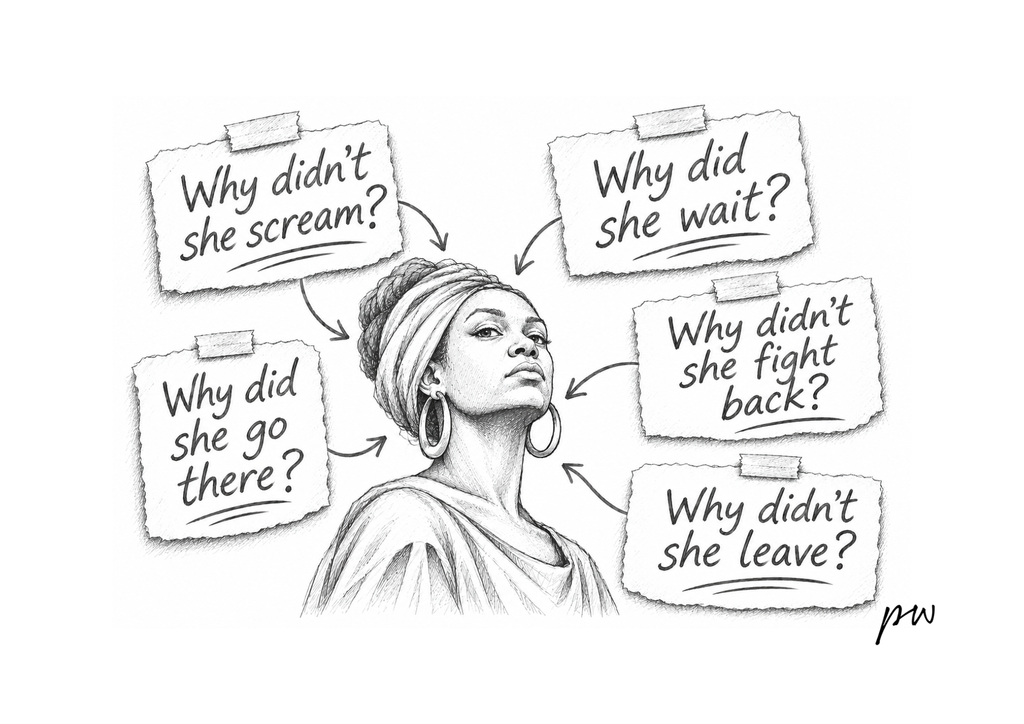
What concerns me is how easily the focus can shift from the conduct of the person accused to the behaviour, choices and character of the woman making the allegation. Her actions before, during and after the experience become subjects of examination, both within the courtroom and in the wider court of public opinion. I often wonder how many women, in considering whether to report sexual violence, are also weighing up the possibility that they will find themselves on trial in the eyes of society. That prospect alone deserves greater consideration in our conversations about the barriers to justice.
These assumptions are familiar beyond the courtroom. We hear them in conversations about relationships, celebrity allegations and news stories involving sexual violence. We question why someone went to a particular place, trusted a particular person, remained in contact or appeared to behave normally afterwards. Sometimes those questions arise from genuine attempts to understand what happened. Yet our expectations can influence which questions we consider reasonable, the details we find suspicious and the explanations we are prepared to accept. This is why I believe our conversations about justice must also examine the beliefs we bring into them.
The questions asked in court reveal something about the beliefs we still carry into court.
The justice system has a responsibility to test evidence carefully. Allegations must be investigated properly, defendants are entitled to a fair trial, and decisions must be grounded in evidence and law. The quality of that process also depends on recognising where harmful stereotypes can influence how evidence is questioned and interpreted. Following Brand’s trial, the Victims’ Commissioner for England and Wales renewed calls for judges to be required to give juries directions about rape myths and misconceptions. Victim Support has also called for meaningful action to address the use of such stereotypes in sexual violence proceedings. These are important contributions to a discussion that should continue long after the immediate reaction to this sentence has subsided.
I think that discussion needs to extend beyond the courtroom. It concerns how organisations respond when allegations first arise, whether people feel able to report misconduct involving influential individuals and what happens when those concerns threaten an established reputation. It also concerns the support available to people navigating investigations, the accessibility of legal processes and the extent to which professional training reflects current understanding of trauma and coercion. Policy and legislative changes can provide important safeguards, but their effectiveness depends on how they are implemented and whether the people responsible for applying them understand the problems those changes are intended to address.
I keep returning to the relationship between reputation and credibility. Public figures are often surrounded by narratives that shape how we understand them. We become familiar with their achievements, personalities and carefully cultivated public images, sometimes to the point that we feel personally invested in their success. When allegations emerge that challenge those perceptions, the public response can become an argument about the person we thought we knew. I find that particularly troubling when admiration for a man’s talent or influence begins to determine how readily people are willing to consider the experiences of women who accuse him of harm.
The response to Brand’s conviction also demonstrates the importance of recognising progress where it occurs. The Crown Prosecution Service has emphasised that the prosecution focused on Brand’s conduct and the evidence of consent. The jury considered the case and returned guilty verdicts, and the sentencing judge acknowledged the seriousness of his offending and the harm caused to the women. Those are significant outcomes. They provide a basis for accountability while leaving room to examine the barriers, attitudes and institutional practices that can make reaching such outcomes extraordinarily difficult.
Patriarchal thinking crosses borders through language, institutions and expectations, shaping whose experiences are believed and whose safety is prioritised.
Over recent months, I’ve been researching documented cases involving violence against women and girls across different countries and legal systems. I could have focused entirely on the UK, because there are more than enough cases here to examine the harmful beliefs that influence responses to abuse and exploitation. I made a deliberate decision to look further afield, however, because I wanted to understand how these beliefs appear across different societies. The legal frameworks, cultural contexts and circumstances vary enormously, but certain expectations remain strikingly familiar.
Across those cases, I’ve encountered assumptions about how women should behave, what makes their accounts credible, how men’s conduct is explained and which interests appear to receive priority. Some of those assumptions have been expressly identified and challenged by courts and official inquiries. Others emerge through public debate and invite us to consider how established ideas about gender, respectability, authority and entitlement influence our interpretations. Examining these connections has reinforced my interest in the relationship between storytelling and power, particularly the consequences that follow when familiar narratives are accepted without sufficient scrutiny.
On 25 November, thePenWarrior will launch When Bias Decides, the inaugural public edition of 16 Days of Writivism. Through sixteen publicly documented cases from around the world, the campaign will explore sixteen harmful beliefs and the barriers to justice they can create. I’ve selected those cases with care, drawing on publicly available evidence and maintaining the distinction between documented findings and the questions they raise. My hope is that readers will recognise something of their own thinking in the assumptions being explored and feel encouraged to examine those beliefs more closely.
The questions raised during Brand’s trial are a timely reminder of why I wanted to undertake this work. His sentence has brought a measure of accountability for four women whose experiences date back many years, and that outcome deserves recognition. I hope the conversation also creates space to consider the women who are still waiting, those who have decided against reporting and those whose experiences may never be examined in court. Meaningful change will require sustained attention to the laws, policies and institutional practices that shape access to justice, alongside a willingness to challenge the attitudes we carry into our everyday lives.
When Bias Decides — 16 Days of Writivism begins on 25 November 2026.
Sixteen real stories. Sixteen harmful beliefs. The barriers to justice they create.
Filed under: Advocacy & Activism
A space where survivor voices are honoured, stereotypes dismantled, and injustice challenged. From gender-based violence and misogynoir to power, policy and representation, these reflections amplify overlooked perspectives and explore the stories that shape a more equitable world. This is where my pen pushes back, and my purpose speaks up.