
The day somebody called Michelle Obama a man in front of the White House, I realised my daughter was already beginning to build her own survival systems.
When somebody shouted that Michelle Obama is a man outside the White House, I felt something I suspect many Black women recognised immediately. I felt weary more than anything else. There was nothing new about it. We have been down this road many times before. Michelle Obama has spent years enduring the kind of scrutiny that seems to follow certain Black women wherever they go. Her appearance has been dissected, her femininity questioned and her humanity reduced to a punchline, often disguised as humour or curiosity.
As Black women, many of us understand instinctively that these attacks are not random. We know they do not begin with Michelle Obama and we know they will not end with her. What I had not fully appreciated was how early these assumptions take root and how casually they can find their way into the world of children. That realisation came closer to home than I would have liked.
I will not share the details because they belong to my daughter and not to me. What I will say is that I discovered she had also been called a man recently. She overheard me muttering under my breath and asked what was wrong. When I aired my frustrations, she said, “Yeah, me too.” Her response was so matter-of-fact that I found myself pausing before I said anything else. It wasn’t just what she had experienced that unsettled me. It was how ordinary it already seemed to her.
This wasn’t the first time somebody had questioned her femininity. Years ago, while she was still in primary school, another child asked whether she was trans. There was no reason for the question other than the fact that she enjoyed playing football with the boys, something that did not fit somebody else’s expectations of what it meant to be “girly”. She is a child, for God’s sake, and yet somehow other children are already learning that femininity can be weaponised and that certain girls are more open to ridicule than others.
“How young girls are when they first realise they may not simply be allowed to be girls.”
I thought I understood misogynoir. Then came the defence. He claimed he had only meant that Michelle Obama worked hard and dealt with adversity “like a man”. I struggled to reconcile that explanation with the insult itself. It was a remarkable defence because it revealed the very assumptions it appeared to deny. Even if we take his explanation at face value, it still rests on the assumption that strength and resilience are somehow masculine qualities. Until then, I thought those assumptions revealed themselves most clearly in the treatment of adult Black women. I hadn’t stopped to consider how early they begin shaping the lives of Black girls.
Many Black women carry memories they rarely revisit. We remember the comments, the jokes and the countless ways we were measured against somebody else’s idea of what a girl should be. Some of us were too dark. Some of us were too loud. Some of us were too sporty or too opinionated. Some of us were told we were not Black enough, while others were made to feel that we were too Black.
Research from Georgetown University found that adults perceive Black girls as less innocent and more adult-like than white girls from as young as five years old. They were also seen as needing less protection, nurturing and comfort. In the UK, the Child Q safeguarding review and organisations such as the NSPCC have drawn attention to similar patterns of adultification, where Black girls are treated as older, stronger and more resilient than they really are.
The Black girl who is expected to cope becomes the Black woman who is expected to endure. Somewhere along the way, strength stops being a compliment and starts becoming an obligation. The stereotype of the strong Black woman sounds admirable until you realise how often it is used to justify withholding support. The angry Black woman trope serves a similar purpose. Many of us know what it means to rehearse our tone, smile when we do not feel like smiling and choose our words carefully because we know how quickly frustration or self-advocacy can be interpreted as aggression.
The consequences are not confined to playgrounds, offices or social media. They show up in places where the stakes are much higher. In the UK, Black women are still significantly more likely to die during pregnancy or shortly after childbirth than white women. Campaigns such as Five X More emerged in response to these disparities. More recent reports have shown that many Black women who raised concerns during labour felt they were not listened to or did not receive appropriate support. Researchers and campaigners have repeatedly pointed to the role of bias, stereotyping and unequal treatment. Those statistics are not abstract to me.
When I gave birth, labour was not progressing as expected. I remember feeling that something wasn’t right and trying to communicate that, only to be encouraged to take deep breaths and use the gas and air. I remember feeling dismissed, although I didn’t yet have the language to explain why. Looking back, what I remember most clearly is not being heard.
Thankfully, a nurse caring for me recognised that things could not simply be left there. She sought another opinion, which resulted in an emergency Caesarean section being performed. My mother has always believed that, had she not kept pushing, things might have ended very differently. After I was discharged, she returned to the hospital carrying a Paco Rabanne Lady Million gift set because “thank you” somehow felt too small. We never took the nurse’s name, but to this day we still refer to her as our “nurse in a million”.
As I have learned more about the experiences of Black women in maternity care, I have found myself returning to that moment again and again. I think about the women whose concerns are not escalated. I think about the mothers who never get to return home to their children. I think about the families left trying to make sense of what happened. Statistics have a way of sounding clinical, but every number represents somebody whose absence altered the course of a family’s life.
“Words matter because they shape assumptions. They influence who we instinctively protect, who we believe and whose pain we take seriously.”
Perhaps that is why I struggle when people dismiss these things as words. Words matter because they shape assumptions. They influence who we instinctively protect, who we believe and whose pain we take seriously. A culture that repeatedly tells itself that Black women are somehow more manly, less vulnerable and better equipped to endure pain should not be surprised when those assumptions begin showing up in schools, workplaces and maternity wards.
Mostly, though, I keep coming back to children. I keep coming back to the fact that somewhere along the way, children learned that questioning a Black girl’s femininity was an insult and that being called a man was something to weaponise against her. Children do not arrive in the world believing these things. They absorb them from the cultures we create, the jokes we tolerate and the assumptions we leave unchallenged.
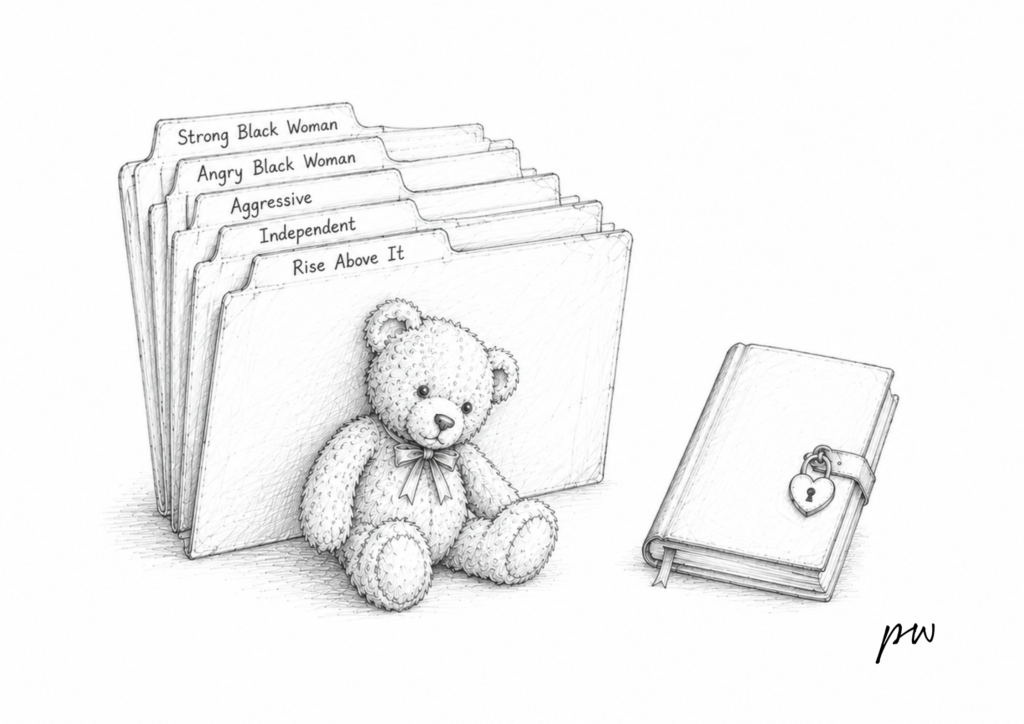
By the time Black girls become Black women, many of us have already learned where to put the things that hurt. Some things get filed under “strong Black woman”. The times we carried on when we wanted to fall apart. The moments we accepted help would not come.
Some sit under “angry Black woman”. The emails rewritten three times. The conversations rehearsed in the car before walking into the room. The smile added to soften a perfectly reasonable point.
Some go under “rise above it”. The comments left unanswered. The battles we decided were too exhausting to fight. The apologies we offered simply to keep the peace.
These filing systems shape how we move through the world, how we speak, how much of ourselves we reveal and how quickly we minimise our own pain. Over time, they stop feeling like survival systems and simply start feeling like us.
“Over time, they stop feeling like survival systems and simply start feeling like us.”
It occurred to me that parenthood is full of pauses like this. Not pauses of uncertainty, but moments spent gathering yourself before saying something you wish your child didn’t need to know yet. Before explaining why some people will question her. Before telling her that the world will sometimes ask her to make herself smaller, quieter or easier to misunderstand. Before trying to reassure her that none of those things have anything to do with who she is.
When I think about Michelle Obama, I think about a woman who has spent years carrying things she never deserved. When I think about my daughter, I think about a girl who is only just beginning to understand herself. What sits heavily with me is the space between them and the possibility that, left unchallenged, my daughter will spend the next thirty years building the same survival systems so many Black women quietly carry.
She is still a child, for God’s sake. I hope she gets to spend more of her life simply being a girl before she has to start creating filing systems she never should have needed in the first place.
Filed under: Advocacy & Activism
A space where survivor voices are honoured, stereotypes dismantled, and injustice challenged. From gender-based violence and misogynoir to power, policy and representation, these reflections amplify overlooked perspectives and explore the stories that shape a more equitable world. This is where my pen pushes back, and my purpose speaks up.