
The proposed social media ban raises an even bigger question: what are we prepared to give children in its place?
For a long time, I thought this was a parenting issue. If social media was having a negative impact on children, surely the answer was for parents to take a more active role in deciding how and when their children accessed it. Parents should parent. Boundaries mattered. Families shouldn’t have to wait for governments to step in before doing what they could and should be doing themselves. That was my view then and, in many ways, it still is.
Then something happened that challenged me to think more deeply about what those boundaries could realistically achieve. I discovered my daughter had been finding ways around the rules I’d put in place. I only found out because I do random checks and, thankfully, she underestimated just how tech-savvy her mother is. There were consequences, of course, and plenty of conversations afterwards. But once I’d got past the initial frustration, I couldn’t stop thinking about why she’d felt the need to do it in the first place.
That experience led me to invest in a Pinwheel phone for her. It wasn’t the easiest option, and it certainly wasn’t the cheapest, but it removed many of the loopholes she had been relying on by stripping away internet browsers, app downloads and the workarounds that make it so easy for children to sidestep parental controls. It felt like a practical way of reinforcing the values and boundaries we were already trying to build at home. I thought I was doing exactly what I had always believed parents should do. What I hadn’t yet understood was that even the most thoughtful parenting decisions don’t happen in isolation.
It wasn’t that she was interested in inappropriate content or had suddenly decided the rules no longer applied to her. She simply didn’t want to be the only one missing out. At the time, she was the only child in her friendship group without access to social media. That’s where friendships carried on after school. That’s where the jokes were shared, plans were made and trends came and went. Every day she was being reminded that part of her friends’ lives existed somewhere she couldn’t go. Looking back, I don’t think she was trying to break the rules as much as she was trying to stay connected to the people who mattered to her.
“She wasn’t trying to break the rules. She was trying to stay connected.”
People often say children in this situation simply need better friends. I’ve always struggled with that response because it overlooks what childhood friendships actually look like. Her friends aren’t bad children. They’re ordinary children growing up in the same culture as everyone else, navigating the same trends, conversations and pressures. Children don’t experience social media as a piece of technology in the way adults often do. To them, it’s where conversations continue after school, where plans are made, where jokes are shared and where friendships are maintained. It made me realise that while parenting matters enormously, there is a limit to what one family can achieve when a child is growing up in a culture that is pulling in a different direction.
For years, I’ve heard people respond to concerns about social media by saying parents simply need to parent better. The difficulty is that parenting isn’t a universal standard. Every family draws the line in a different place. Some are comfortable with unrestricted access at eleven. Others would rather wait until sixteen. Some monitor every app. Others hardly check at all. Those children still spend their days together. They sit in the same classrooms, build the same friendships and influence one another every single day. That is why I now see the proposed ban differently. It isn’t about replacing parental responsibility. It’s recognising that raising children has always been something families do within a wider society, not apart from it.
That is where I believe the value of the ban lies. It doesn’t remove parental responsibility, but it does make it easier for parents to hold the boundaries they’ve set for their children. The child whose parents say no is no longer automatically the odd one out because everyone else has unrestricted access. Parents are no longer trying to negotiate against an entire culture on their own. I don’t see that as the government stepping into family life. I see it as recognising that some challenges are too big to leave entirely to individual families.
But I’d be wary of treating the ban as the solution rather than the beginning. Too often, conversations about TikTok, Snapchat, Instagram, Discord and gaming platforms focus only on the harms. We talk about cyberbullying, addictive algorithms, harmful content and the impact on mental health, and those concerns are entirely valid. What we spend far less time talking about is why these platforms became so central to young people’s lives in the first place.
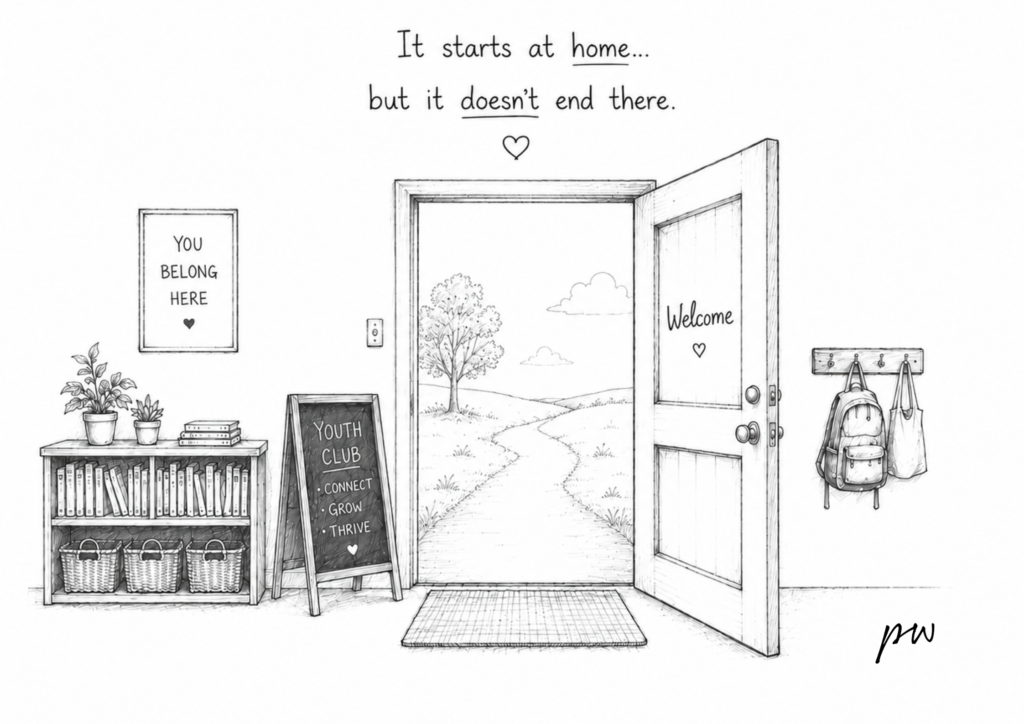
Youth clubs, community centres, libraries, church groups, sports clubs and simply knocking for your friends all gave young people places to spend time, build relationships and feel part of something. As many of those spaces have disappeared, social media has stepped in to fill some of the gaps. It is where friendships continue, weekend plans are made, interests are shared, communities are found and boredom is eased. Whether we like it or not, that has become part of modern childhood.
“If we remove one place where young people gather, we have to ask what we’re putting in its place.”
For that reason, I welcome the ban, but don’t see it as the end of the conversation. If we remove one of the places where young people now gather, we also have to ask what we’re putting in its place. Banning social media without rebuilding opportunities for children to connect would be like closing a community centre without opening another one. Young people’s need for belonging doesn’t disappear because an app does. We all look for places where we feel accepted and understood, and young people are no different. If we don’t create healthier spaces for those needs to be met, they will simply find other ways to meet them.
That’s where the bigger conversation begins. The proposed ban gives us an opportunity to think beyond the apps themselves and ask what kind of childhood we’re creating and what kind of society we’re asking young people to grow up in. Protecting children has never been just about removing risks. It’s also about creating places where they can safely belong.
The same thinking applies to AI. I’m not calling for an AI ban. I use AI almost every day and can already see how much good it can do. What I don’t want is for us to repeat the pattern we’ve seen with social media, where legitimate concerns were too often dismissed until the evidence became impossible to ignore. We don’t have to choose between embracing innovation and putting sensible safeguards in place.
“Children don’t experience social media as a piece of technology in the way adults often do.”
Children should not be able to create AI characters that encourage self-harm or suicide. They should not be interacting with systems that simulate emotional intimacy without meaningful safeguards in place, nor should they become the generation through which society discovers where the limits should have been all along. Regulation is not the opposite of innovation. It’s what helps innovation develop responsibly.
I still believe parenting starts at home. I still believe parents have a responsibility to guide, protect and teach their children. I’ve come to appreciate just how much we’ve quietly asked parents to carry on their own. Children are shaped by what happens at home, but also by the friendships they build, the communities they grow up in and the technology that surrounds them. If we’re serious about protecting the next generation, we can’t keep pretending those wider influences are someone else’s responsibility. Parenting will always matter, but so will the world we build around it.
Filed under: Unlearning Myths
A space for questioning what we think we know. Challenging assumptions, examining stereotypes, and exploring the stories we accept as truth. From culture and identity to politics, power and everyday life, these reflections explore what happens when we look beyond the narratives we’ve been taught to believe.